Electric vehicle (EV) adoption is no longer a future concept. It is happening now across fleets, logistics operations, municipalities, and commercial businesses. At the center of this transition is EV charging technology, which enables vehicles to receive the power they need to operate reliably day after day.
Electric vehicle charging works by transferring electricity from the grid through an EV charger and into an electric vehicle battery. This process relies on a physical EV charging connector that links the charging station to the vehicle. That connection is where compatibility, power delivery, and performance all come together.
For businesses, this is not just a technical detail. It directly impacts operations. If the connector type does not match the vehicle, charging cannot occur. If the system is not designed correctly, charging speeds can slow down, creating downtime that affects productivity. Over time, those inefficiencies add up through missed routes, delayed deliveries, and underutilized assets.
Understanding EV charging connector types helps avoid these issues. It allows businesses to choose the right infrastructure, support multiple vehicles, and plan for long-term growth. This is especially important for fleets, where charging efficiency plays a major role in daily scheduling, route planning, and overall asset utilization.
EV charging technology has evolved rapidly. Early systems focused on low-power charging that required long dwell times. Today, DC charging systems allow vehicles to recharge in a fraction of that time. This shift has opened the door for broader adoption, especially in industries that depend on uptime and predictable operations.
From depot charging to distributed networks, understanding the role of the charging connector is the first step in building a reliable solution that can scale alongside your business.
The Different EV Charging Connector Types
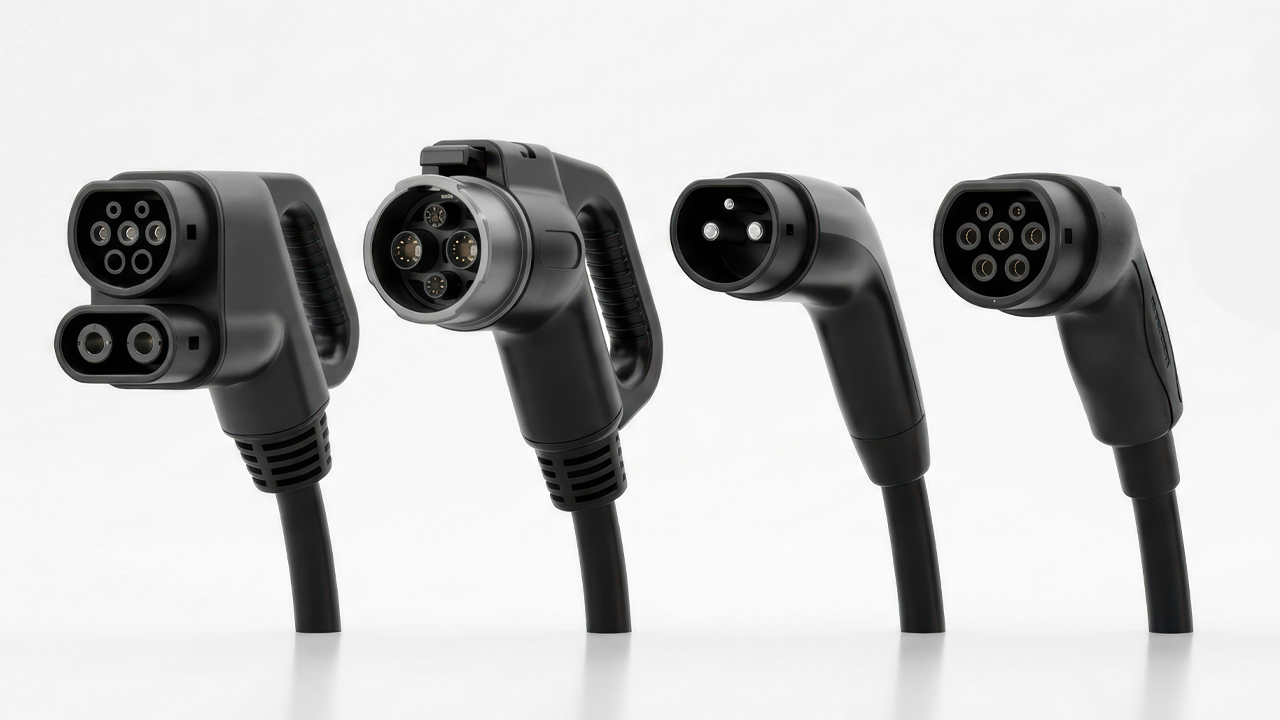
There are several EV charging connector types used across the EV ecosystem today. Each EV charging connector is designed to meet specific requirements related to power delivery, safety, and regional standards.
The most common connector types include Type 1, Type 2, CCS, CHAdeMO, and Tesla (NACS) connectors. Each serves a different purpose and is used in different markets or applications depending on vehicle design and infrastructure availability.
Type 1 connectors are commonly used in North America and support AC charging. They are typically found in residential and light commercial settings where charging occurs over longer periods. Type 2 connectors are more widely used in Europe and support both single-phase and three-phase charging, allowing for higher power levels in certain installations.
The combined charging system has become a leading standard for modern EV charging. It integrates both AC and DC charging into a single EV connector, making it more versatile. This allows EV drivers to use the same connector for standard charging and high-speed applications, simplifying both vehicle design and infrastructure deployment.
CHAdeMO is another standard used for DC charging. It was one of the first widely adopted solutions for fast charging, but its use has declined in favor of CCS in many regions as manufacturers align around fewer standards.
Tesla developed its own connector system, supported by the Tesla Supercharger Network. This system provides rapid charging and has influenced the direction of industry standards as other manufacturers adopt similar designs or move toward compatibility.
Each connector type has advantages and limitations. Some support higher power levels, while others are more widely available or easier to deploy. The existence of multiple connector types reflects the evolution of the industry and the need to support different vehicles, charging speeds, and operating environments.
Global EV Charging Standards and Compatibility
EV charging standards vary across the world, and these differences directly affect connector compatibility. North America primarily uses Type 1 and CCS, while Europe relies on Type 2 and CCS. In some regions, CHAdeMO remains in use for certain vehicles, particularly older models.
These differences create challenges for businesses operating across multiple regions or managing mixed fleets. A charging station designed for one standard may not work for all vehicles without additional equipment or adapters. This can introduce complexity into operations and increase infrastructure costs if not planned correctly.
Compatibility is not limited to the physical connector. It also involves communication protocols, voltage levels, and output current type. These factors determine how power is delivered, how efficiently energy flows, and how the vehicle interacts with the charger during a session.
For fleet operators, this complexity requires careful planning. Selecting infrastructure that supports multiple standards can help reduce limitations and improve flexibility. It also allows businesses to adapt as new vehicle models enter the market without needing to replace existing equipment.
Understanding global standards helps businesses avoid compatibility issues and plan for future expansion. It also protects the value of today’s investments as the industry evolves and new technologies are introduced.
EV Charging Speeds and Technology Advancements
Charging speed is one of the most important considerations in EV adoption. The ability to recharge quickly can determine whether a vehicle is ready for its next route or delayed due to limited power availability.
There are three primary levels of EV charging:
- Level 1 charging uses standard outlets and provides the lowest power output. It is typically used for residential charging or low-demand scenarios where vehicles remain parked for extended periods.
- Level 2 charging provides higher power and is commonly used in workplace, depot, and commercial environments. It offers a practical balance between cost and performance, making it suitable for many day-to-day applications.
- Level 3 charging – also known as DC charging – delivers power directly to the battery. This method bypasses the onboard charger and significantly increases charging speed. A DC fast charger can deliver a substantial amount of energy in a short period, making it ideal for high-demand operations where downtime must be minimized.
Advancements in DC fast charging technology continue to improve performance. New systems are capable of delivering higher power levels while maintaining safety and reliability. These improvements reduce charging time and increase vehicle availability, which is critical for operations that rely on tight schedules.
Fast charging is particularly important for fleets that operate on defined routes or time-sensitive deliveries. Reducing charging time allows vehicles to spend more time in service and less time connected to infrastructure.
At InCharge Energy, we work with organizations to design charging systems that align with real-world use and support a range of charging speeds. Our EV Charging Stations are built to handle both standard and high-speed applications, helping businesses optimize operations and improve efficiency across their fleets.
EV Charging Infrastructure Planning and Policy
The growth of EV charging infrastructure is driven by increasing demand and supportive policies. Governments and private organizations are investing in new charging stations to support the transition to electric vehicles across multiple sectors.
Policies play a key role in this development. Incentives, grants, and regulations encourage businesses to adopt EV charging solutions and expand access. These programs help offset initial costs and accelerate deployment timelines.
Despite progress, challenges remain. Grid capacity, installation costs, and site planning can impact how quickly infrastructure is deployed. Businesses must evaluate electrical capacity, permitting requirements, and long-term expansion needs when designing their systems.
At the same time, there are significant opportunities. Expanding charging infrastructure can improve fleet operations, reduce fuel costs, and support sustainability goals. It can also enhance customer experience and position businesses as leaders in electrification.
We provide end-to-end solutions to help businesses navigate these challenges. From planning and design to installation and ongoing management, we support every stage of infrastructure development. Learn more about InCharge Energy’s Innovative Hardware.
Choosing the Right EV Charging Connector for Your Fleet
Selecting the right EV charging connector requires an understanding of vehicle requirements, charging needs, and infrastructure capabilities. Each EV is designed to work with specific connector standards, and matching those requirements is essential for efficient operation.
Factors to consider include charging speed, connector availability, and system compatibility. For fleets, these decisions impact daily operations, long-term planning, and the ability to scale as demand increases. Vehicles that require fast charging may need access to DC charging infrastructure, while others may rely on Level 2 systems for overnight charging. Understanding these needs allows businesses to design systems that align with operational goals.
Connector selection also affects future flexibility. As new standards emerge, infrastructure must be able to adapt. Choosing systems that support multiple connector types can reduce the need for costly upgrades and help extend the life of your investment.
With so many connector types and charger brands in the market, having a service partner who can support all of them is equally important. InCharge Energy’s in-house technicians are trained across multiple charger brands, so your infrastructure stays operational regardless of what equipment you’re running.
Key Takeaways on EV Connector Types
Understanding EV charging connector types is essential for building a charging strategy that actually works in the real world. Each connector plays a direct role in how power is delivered, how quickly vehicles return to service, and how effectively your infrastructure performs day to day.
The industry is moving quickly. Standards are becoming more aligned, and technology continues to push charging speeds higher. Solutions like the combined charging system are helping reduce operational friction, while improvements in fast charging are making it easier to keep vehicles on the road and out of the queue.
For businesses, staying informed is not optional. Charging infrastructure is a long-term investment, and the decisions you make now will shape performance, flexibility, and cost for years to come.
At InCharge Energy, we help organizations turn those decisions into practical, scalable solutions. Providing so much more than hardware, our team delivers complete EV charging solutions that support fleets, workplaces, and commercial operations at scale. From site design and equipment installation to software integration and ongoing service, we manage every phase so that your system performs reliably from day one. As your needs evolve, your infrastructure is built to keep up.
If you’re planning your next step in electrification, now is the time to get it right. Connect with our team today to design a charging solution and keep it running, with hardware, installation, and ongoing service that fits your operation today and positions you for what’s next.